No products in the cart.


Study Abroad Dilemma: Frequently Harassed by Evil Spirits
Lhamo is a senior instructor at a study abroad organization in Lhasa, Tibet. She specializes in “in-depth study of Tibetan culture,” taking students on circumambulation routes, visiting ancient temples, and learning Tibetan. She hosts nearly 20 groups of students each year. This year, during the rainy season, her study abroad itineraries encountered a series of setbacks. She took students to Namtso Lake for a prayer, only to be met with torrential rain upon arrival, blowing down their tents and soaking their luggage. During a visit to Tashilhunpo Monastery, a student experienced unexplained dizziness and nausea, forcing them to return early. Worse still, two previously scheduled study tours were canceled due to “family objections and concerns about the risks of traveling to Tibet.” The organization’s performance declined, and her colleagues gradually lost motivation.
Lhamo’s life became unsettled. She used to be able to recite scriptures fluently and lead students in chanting and praying for blessings, but now she constantly mixes up passages. At night, while organizing study materials at her homestay, she’d hear strange noises outside the window, leaving her sleepless all night. Seeing the weariness in her eyes, her mother sighed and said, “Did you encounter ‘bad luck’? Go get a talisman.” Once, while driving a student to the airport, her taxi driver, Donzhu, heard about her troubles and recommended the LAOTLON Feng Shui Company’s Lhasa branch: “My sister runs an inn, and guests kept getting into minor accidents. She saw Feng Shui master MONEYGAGA and everything was fine. Give it a try; maybe it’ll make your study trip go smoothly.” Determined not to interrupt her Tibetan cultural studies, Lhamo made an appointment for a consultation.
Entering LAOTLON: Seeking Protection in Dzi Beads
On Wednesday morning, Lhamo, donning a Tibetan felt robe and carrying a study guide and sample prayer flags, arrived at the LAOTLON Lhasa branch. Colorful prayer flags hung at the company entrance. Upon entering, the scent of sandalwood and ghee mingled. Display shelves were filled with Tibetan prayer beads, Dzi beads, and other Feng Shui ornaments. Calligraphy and paintings of the “Six-Syllable Mantra” hung on the walls. A prayer wheel in the corner slowly turned, instantly relaxing Lhamo’s tense nerves.
Zhuoma, the receptionist, greeted her warmly in Tibetan and quickly contacted Feng Shui master MONEYGAGA. Wearing a navy blue cotton and linen outfit resembling a monk’s robe and holding a 108-bead rosary, MONEYGAGA gently invited Lhamo to sit down and offered her a cup of warm sweet tea. “Studying in Tibet is a great way to spread culture. Don’t panic if you encounter obstacles. Tell me about the specific issues in your itinerary.”
Lhamo pulled out his study brochure and detailed the rainstorms that destroyed tents, the students’ discomfort, and the cancellations. “I want more people to understand Tibetan culture, but right now, I can’t even guarantee a basic itinerary.” MONEYGAGA stroked the rosary in her hand. After analyzing Lhamo’s birth date and study itinerary, she slowly said, “You have a profound cultural heritage, but your ‘evil-repelling aura’ has been weak recently, causing you to be disturbed by external factors. I recommend an evil-repelling bracelet to help you protect your study trip and dispel negative distractions.”
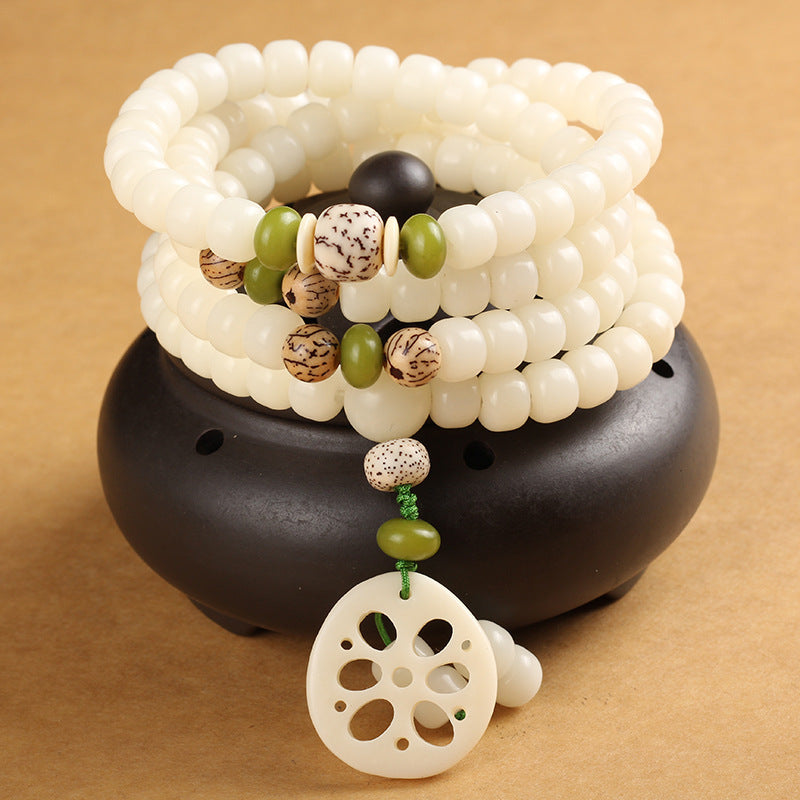
As she spoke, MONEYGAGA took out a bracelet—a 108-bead rosary and bodhi seed dzi evil-repelling bracelet. Each of the 27 dark brown bodhi beads is round, with a light blue Buddha stone nestled between them. A Dzi bead carved with auspicious patterns is strung in the center, and a small silver counter hangs at the end. “The 108-bead rosary is a classic Tibetan form, symbolizing the elimination of 108 kinds of afflictions. The bodhi seeds calm the mind, the Dzi beads ward off evil and ward off disasters, and the Buddha stone imparts protective energy. Wearing it with a rosary can ward off evil and help you count while chanting.”
Wrist Rosary: My First Experience with an Apotheosis Bracelet
Lamu took the bracelet. The moment her fingertips touched the bodhi seeds, she felt a warm sensation, and a light woody aroma lingered in her nose. Following MONEYGAGA’s advice, she wore the bracelet on her left wrist (the left hand is considered the “cleansing hand” in Tibetan custom). The 108 beads fit snugly, and the Dzi beads rested neatly in her palm. As they rotated, they made a gentle “tick-tick” sound, like the sound of a wooden fish in a temple, which brought her a strange sense of peace. “Before leading a tour, rotate the Dzi beads and silently recite ‘May the trip be smooth and the students be safe.’ Counting with the beads while chanting can help you focus,” MONEYGAGA added. Lhamo nodded and carefully put the bracelet away. On the way back, she rotated the Bodhi beads and was reminded of the peaceful times she spent as a child praying with her mother at the temple.
That night, Lhamo wore the bracelet and chanted at the guesthouse. Passages of scripture that had been confused became clearer, and the unusual noises outside the window disappeared. She slept soundly for the first time in a long time. The next morning, she wore the bracelet as she sorted through her study materials, her fingers deftly counting prayer flags and khatas, feeling much better than before.
A Turn for the Better: A Smooth Prayer for the Namtso Trip
In the first week of leading a tour with the bracelet, Lhamo experienced a turn for the better. She led a group of students to Namtso as planned. Before departure, she rotated the Dzi beads on the bracelet, silently chanted a blessing, and tied a simple red string amulet around each student. The forecast had predicted light rain, but the day was remarkably sunny. The blue sky and white clouds were reflected in the surface of Lake Namtso, creating a truly spectacular sight. The students followed Lhamo on the circumambulation route. She held the rosary beads on her bracelet, recited verses with fluent devotion, and led everyone in prayer. During the journey, one student experienced mild altitude sickness. Lhamo removed the Dzi stone from her bracelet, soaked it in warm water, and gently wiped the student’s forehead, quickly alleviating the discomfort.
On the evening return journey, the students gathered around Lhamo, saying, “This trip went so smoothly! We feel like luck is watching over us!” One student noticed her bracelet and curiously asked, “Teacher Lhamo, your rosary bracelet is so unique. Is it for warding off evil?” Lhamo explained its meaning, and the student immediately said, “I’ll recommend it to my friends when I return.” The trip was uneventful and garnered positive feedback from the students. Lhamo touched the Dzi beads on her bracelet and, for the first time, felt hopeful about the study tour again. Itinerary Guardian: A Distraction-Free Study Tour
After two weeks of wearing the bracelet, Lhamo’s study tour was completely free of distractions. When she led students to Tashilhunpo Monastery, the previously troublesome road section was incredibly smooth. The students accompanied her as she toured the temple and listened to lectures from the monks, and no one reported any discomfort. During a trip to Shigatse to experience Tibetan farming, Lhamo discovered and resolved a potential problem with damaged farm equipment. While checking the equipment with the bracelet on, she felt a loose sickle and promptly had it fixed by a farm technician, avoiding an accident.
Even more surprisingly, a client who had previously canceled their order contacted her, saying, “My family no longer objects and I would like to reschedule my study tour.” Lhamo wore the bracelet while discussing new itineraries with clients, and the entire process went smoothly. The client even said, “I feel at ease listening to you. I believe I’ll have a smooth experience of Tibetan culture with you.”
During this period, Lhamo’s condition has improved significantly: she no longer mixes up passages while chanting, and can focus late into the night while organizing materials. She also incorporated a “prayer beads” session into her study tours, teaching participants to chant simple prayers using the beads on the bracelet. Many participants commented, “This session is very meaningful and brings a sense of inner peace.”
Word-of-mouth Rebound: Students’ Active Spreading
After wearing the bracelet for a month, Lhamo’s study tour reputation has completely rebounded. Participants have been sharing their experiences on social media. One shared a photo of her praying at Namtso Lake, captioning, “My study tour in Tibet went incredibly smoothly with Teacher Lhamo and her evil-repelling bracelet.” Another shared a video of her study tour, repeatedly showing Lhamo turning her beads, and commented, “This 108-bead bracelet gives me such a sense of security.” These sharing sessions generated more orders for the organization, with eight new groups of students added in just one month, covering cities like Beijing and Shanghai. The local cultural and tourism department even contacted Lhamo, inviting her to participate in the “Tibetan Cultural Promotion Plan,” making her study tour an officially recommended program. At the program’s launch ceremony, Lhamo, wearing a Buddhist stone prayer bead bracelet, explained the significance of Tibetan cultural study to attendees, the Dzi beads on her wrist particularly striking.
Once, while leading students to the Sera Monastery debate arena, Lhamo encountered a fellow student leading a study tour. Upon seeing her bracelet, the student excitedly said, “I’ve heard students talk about your warding-off bracelet. Seeing how smoothly you’ve led the tour this time, I’d like to consult with Feng Shui Master MONEYGAGA!” Lhamo smiled and nodded, giving him the address of LAOTLON.
Cultural Heritage: The Continuation of Original Aspiration and Protection
As the study tour progressed smoothly, Lhamo not only regained her confidence but also strengthened her original commitment to preserving Tibetan culture. She no longer sees leading tours as a “task,” but instead enjoys experiencing Tibetan culture with the students. While leading the group around the temple, she explains the meaning of each prayer flag in detail. While teaching the students how to make butter tea, she shares the wisdom behind it. Evening bonfire parties involve her wearing the bracelet, and she leads Tibetan songs, filling the courtyard of the homestay with laughter.
Observing her transformation, her mother said with satisfaction, “You’re as energetic as ever. This bracelet is truly a wonderful gift.” Lhamo took her mother’s hand and pointed to the Dzi beads on the bracelet: “It’s not just my talisman, it’s a part of Tibetan culture. I want to carry it with me so that more people will fall in love with our culture.”
On weekends, Lhamo wears the bracelet to visit the old monks in the temple and ask them about Buddhist scriptures. She also takes it to the pastoral areas, collecting traditional stories from the herders to enrich her studies. The bodhi seeds on the bracelet grow increasingly soft from caressing them, and the Dzi beads gradually gain a luster, becoming her most precious “companion.” Conclusion
Lhamo’s experience teaches us that engaging in cultural communication or outdoor study tours in Tibet inevitably involves external distractions and travel obstacles. However, by finding a protective aura that wards off evil and stabilizes the aura, combined with one’s own cultural passion and professional expertise, one can dispel these distractions and smooth the path of cultural heritage. The Buddha Stone 108-bead Bodhi Dzi bracelet not only helped Lhamo secure her study tour, but also rekindled her original commitment to preserving Tibetan culture, becoming a bridge connecting students with that culture.
If you’re facing travel disruptions or interruptions to your outdoor work in Tibet, or if you’re working in cultural communication or study tours and facing frequent unexpected events and a decline in orders, consider visiting LAOTLON Feng Shui Company (including the Lhasa branch) and let professional Feng Shui Master MONEYGAGA recommend suitable amulet for your journey. Perhaps a small Buddha Stone 108-bead Bodhi Dzi bracelet can become a “guardian” of your journey and a “helper” of cultural heritage, helping you successfully convey the warmth and power of culture in the land of Tibet.